






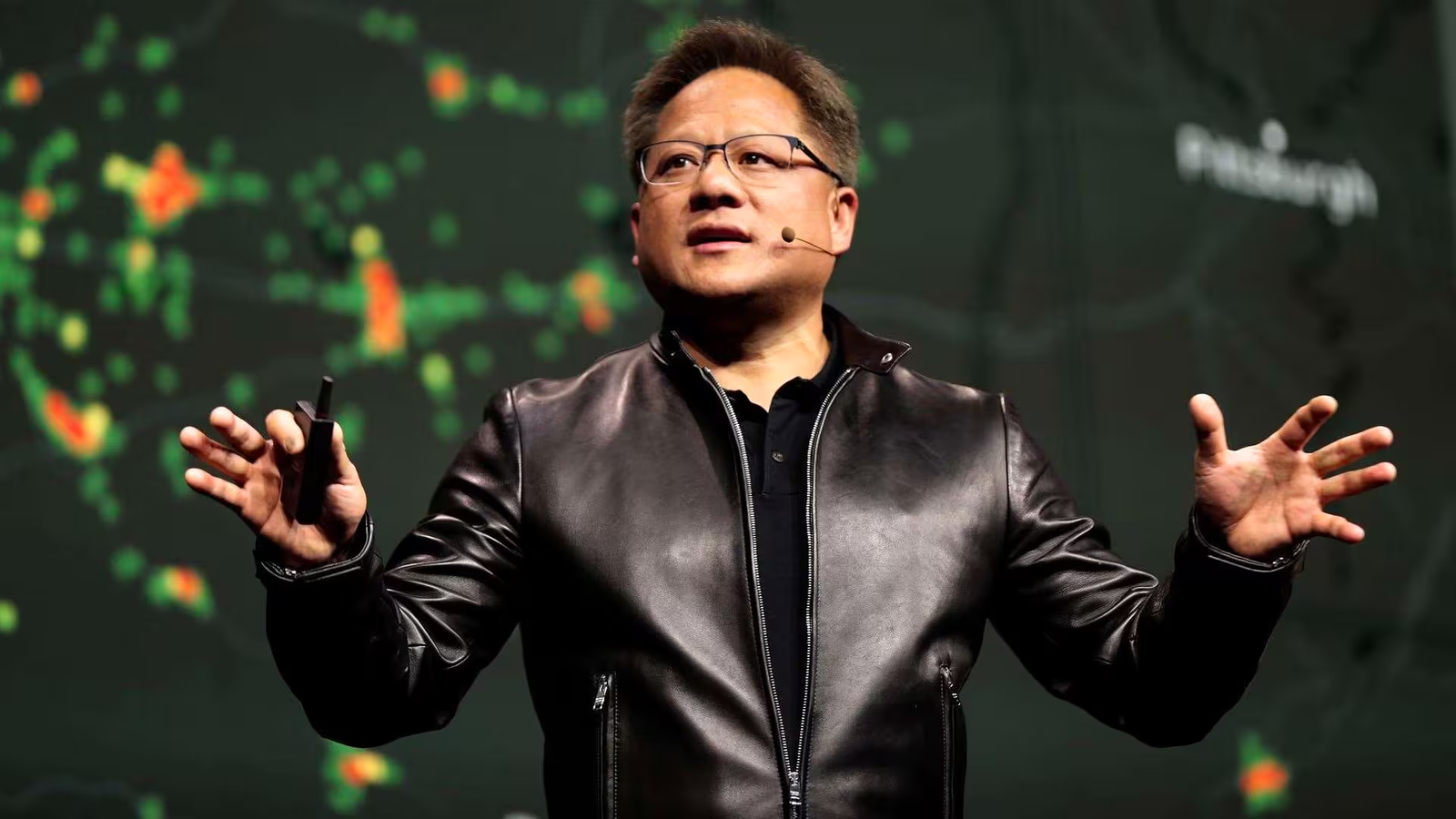
Davos, Switzerland — Jensen Huang, the chief executive of Nvidia, said Wednesday that artificial intelligence–powered robotics represents a “once-in-a-generation” opportunity for Europe, as the region looks to leverage its industrial strength in the next phase of AI development.
Speaking at the World Economic Forum annual meeting in Davos, Huang emphasized that Europe’s deep manufacturing expertise positions it uniquely to benefit from the convergence of AI and physical systems.
“Europe has an incredibly strong industrial and manufacturing base,” Huang said. “When you fuse that capability with artificial intelligence, you enter the era of physical AI — robotics — and that changes everything.”
Huang suggested that robotics could allow Europe to move beyond the software-dominated phase of the digital economy, which has largely been led by the United States. Instead, the region has an opportunity to leap directly into large-scale deployment of AI in factories, logistics networks, and industrial automation.
Momentum Builds Around AI Robotics
Interest in autonomous and intelligent robotics has accelerated sharply as advances in machine learning and generative AI expand what machines can perceive, reason, and execute in the physical world.
Several major European manufacturers have announced new robotics initiatives over the past year, including Siemens, Mercedes-Benz Group, Volvo, and Schaeffler. These companies are increasingly partnering with AI and robotics firms to automate production lines and improve operational efficiency.
U.S. technology companies are also doubling down on the sector. Elon Musk has said humanoid robots could account for the majority of Tesla’s long-term value, while Google DeepMind has released AI models designed specifically for robotics applications. Nvidia itself has announced partnerships with Alphabet to develop platforms for physical AI.
Investor interest reflects this momentum. According to Dealroom, companies focused on robotics raised a record $26.5 billion globally in 2025, underscoring growing confidence in the sector’s commercial potential.
Energy Supply a Critical Constraint
Despite the opportunity, Huang warned that Europe must address structural challenges — particularly energy availability — to fully capitalize on AI-driven robotics.
To support large-scale AI infrastructure, including data centers and advanced manufacturing facilities, Europe must significantly expand its energy supply, Huang said. The region currently faces some of the highest electricity costs in the world, which could hinder investment and deployment.
“You have to get serious about increasing your energy supply,” Huang said. “Without it, you can’t build the infrastructure layer needed for a rich AI ecosystem.”
The issue has emerged as a central theme at Davos this year. Satya Nadella noted earlier in the week that energy costs may ultimately determine which countries succeed in the global AI race, as hyperscale computing demands surge.
Europe has already faced constraints as cloud providers and AI developers race to roll out new data centers. However, Huang said the pace of investment shows no signs of slowing.
Trillions in Infrastructure Ahead
Huang described the current AI boom as the largest infrastructure buildout in human history, noting that the industry has already invested hundreds of billions of dollars.
“We’re only at the beginning,” he said. “There are trillions of dollars of infrastructure that still need to be built.”
For Europe, the stakes are high. If energy challenges are addressed and industrial strengths fully mobilized, AI robotics could become a defining growth engine for the region — one that reshapes manufacturing, strengthens competitiveness, and anchors Europe’s role in the next technological era.

