

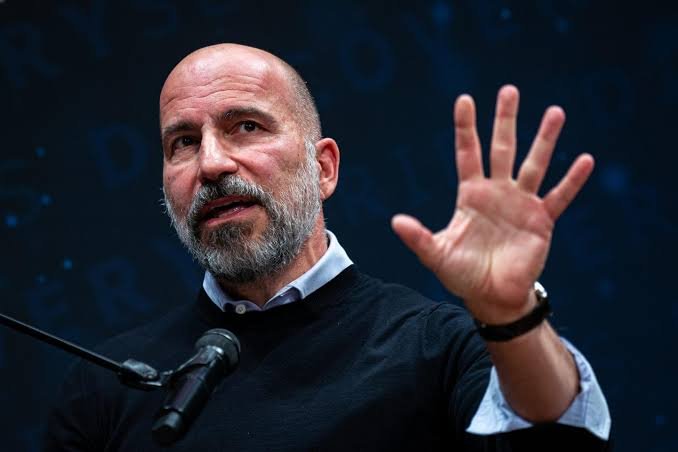
Dara Khosrowshahi became Uber’s CEO at a difficult moment. The company had grown rapidly, but it also faced major losses, leadership problems, regulatory challenges, and questions about its long-term business model. Khosrowshahi took over in 2017 and began a major effort to make Uber more disciplined, efficient, and focused on sustainable growth.
His leadership helped change the way Uber approached business. Instead of focusing only on expanding into new markets and increasing ride volume, the company increasingly emphasized profitability, stronger operations, technology, and financial discipline.
Today, Khosrowshahi is widely associated with Uber’s transformation from a high-growth startup into a more mature global technology and transportation company.
Who Is Dara Khosrowshahi?
Dara Khosrowshahi is an Iranian-American business executive and the CEO of Uber. Before joining Uber, he was best known for leading Expedia for more than a decade.
Khosrowshahi joined Uber in 2017, replacing co-founder Travis Kalanick as CEO. His appointment came during a period when Uber needed to rebuild its corporate culture and improve its relationship with employees, investors, regulators, drivers, and customers.
His experience at Expedia gave him a strong background in technology, travel, international markets, and large-scale digital businesses. He brought this experience to Uber and began changing the company’s approach to growth.
Why Did Uber Need a Major Change?
Uber had become one of the world’s most recognizable technology companies, but rapid expansion came with significant costs.
The company invested heavily in entering new markets, offering incentives, developing technology, and competing aggressively with rivals. This helped Uber grow quickly, but it also created pressure on its finances.
When Khosrowshahi became CEO, he faced several major challenges:
- Large financial losses
- Strong competition
- Regulatory pressure
- Corporate culture problems
- High operating expenses
- Complex international operations
- Investor concerns about profitability
Instead of simply trying to grow faster, Khosrowshahi focused on building a business that could eventually generate consistent profits.
Khosrowshahi’s Focus on Profitability
One of the biggest changes under Khosrowshahi was a stronger focus on financial discipline.
Uber had historically been associated with aggressive growth. Under Khosrowshahi, the company increasingly looked at whether its businesses could create sustainable economic value.
This meant examining markets, products, expenses, incentives, and investments more carefully.
The goal was not to stop growth. Instead, Uber wanted growth that could eventually translate into stronger financial results.
This was an important shift because technology companies often prioritize user growth and market share during their early stages. As Uber became more mature, investors increasingly wanted evidence that the company could turn its enormous scale into sustainable earnings.
Simplifying Uber’s Business
Khosrowshahi also made important decisions about which businesses Uber should operate.
Under his leadership, Uber moved away from some operations that were difficult to scale or did not fit its long-term strategy. The company also sold or reduced its involvement in certain businesses and markets.
This helped Uber concentrate on its strongest platforms and businesses.
The strategy was relatively simple: focus resources on areas where Uber had a strong competitive position and where the company could build long-term value.
The Importance of Uber Eats
Uber Eats became an important part of the company’s transformation.
Originally created as a food-delivery service, Uber Eats expanded Uber’s relationship with consumers beyond transportation.
The COVID-19 pandemic also changed consumer behavior dramatically. With fewer people traveling, demand for traditional rides declined, while food delivery became much more important.
Uber’s broader platform helped it adapt to this changing environment.
Over time, Uber also expanded its delivery business beyond restaurants, giving customers access to groceries, convenience products, and other goods in some markets.
This helped strengthen the idea of Uber as a broader technology platform rather than simply a ride-hailing company.
Building a More Efficient Uber
Profitability is not only about increasing revenue. It also depends on controlling costs.
Khosrowshahi pushed Uber toward greater operational efficiency. Technology became increasingly important in this process.
Uber uses algorithms and data to match riders and drivers, estimate arrival times, manage pricing, improve routing, and balance supply and demand.
The company also benefits from its large global network. As more users and drivers participate, Uber can use its technology and data more effectively across its platform.
The challenge for Khosrowshahi was to turn this scale into better economics.
From Startup Culture to Public Company Discipline
Another major part of Khosrowshahi’s leadership was cultural change.
Uber had developed a reputation for an aggressive startup culture during its early years. Khosrowshahi attempted to create a more professional corporate environment with stronger governance and clearer accountability.
This became especially important after Uber went public in 2019.
As a public company, Uber had to provide investors with greater transparency about its financial performance, risks, and future plans.
Khosrowshahi’s leadership therefore involved balancing two different goals: maintaining the innovation and speed of a technology company while introducing the financial discipline expected from a large public corporation.
How Khosrowshahi Changed Uber’s Long-Term Strategy
The biggest transformation was arguably the change in mindset.
Uber’s early strategy was heavily focused on expansion and market disruption. Khosrowshahi’s approach became more focused on sustainable growth.
The company increasingly emphasized:
- Profitability
- Free cash flow
- Operational efficiency
- Stronger customer relationships
- Platform expansion
- Technology
- Cost management
- Long-term shareholder value
This did not mean Uber stopped investing in growth. Instead, the company became more selective about where it invested.
What Can Businesses Learn From Dara Khosrowshahi?
Khosrowshahi’s leadership offers several lessons for other businesses.
First, rapid growth is not enough. A company eventually needs a sustainable financial model.
Second, leaders must be willing to change strategy when circumstances change.
Third, simplifying a business can sometimes create more value than expanding into every possible market.
Finally, technology becomes more powerful when combined with operational discipline.
Uber’s journey shows that a company can move from an aggressive growth phase toward a more mature and financially focused business without completely abandoning innovation.
Conclusion
Dara Khosrowshahi’s time at Uber has been defined by transformation. When he became CEO in 2017, Uber was a rapidly growing company facing financial, cultural, regulatory, and operational challenges.
Khosrowshahi worked to change that model by focusing more heavily on profitability, efficiency, business discipline, and sustainable growth.
His strategy helped Uber evolve beyond its identity as a ride-hailing startup. The company developed a broader platform that includes mobility and delivery services while placing greater emphasis on financial performance.
The Uber story under Dara Khosrowshahi demonstrates an important business lesson: growth can build scale, but disciplined growth is what can turn scale into a sustainable company.
